
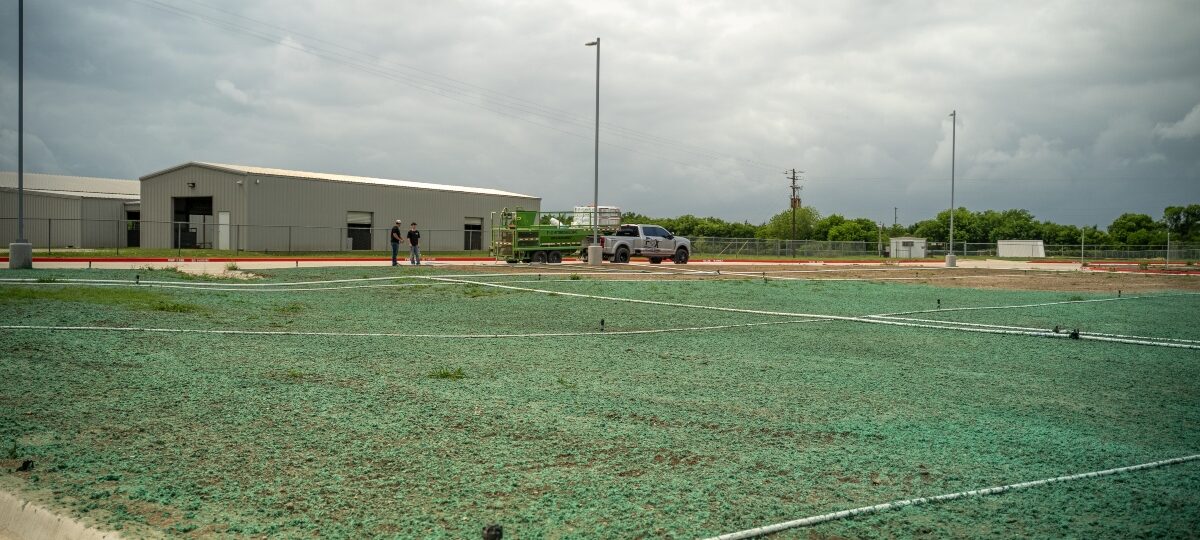
Erosion can become a serious concern across North Texas when exposed soil is affected by intense rainfall, strong winds, construction activity, and long periods of hot weather. Sloped properties are particularly vulnerable because water can move rapidly downhill, carrying soil and newly planted seed with it. Once erosion begins, it can create ruts, expose roots, damage drainage areas, and make vegetation establishment much harder. Proper surface protection is therefore an important consideration when developing or restoring disturbed land.
Hydromulch provides a practical way to protect seeded soil during the early stages of vegetation establishment. Applied hydraulically as a mixture of mulch, water, seed, and selected additives, it creates a protective covering across the soil surface. This layer can help reduce direct rainfall impact, slow surface water movement, and retain moisture around developing seed. For projects requiring Hydromulch North Texas solutions, the material can be particularly useful when soil needs temporary protection while vegetation develops.
How Hydromulch Helps Control Surface Erosion
One of the primary benefits of hydromulch is its ability to create relatively uniform soil coverage. Bare soil is easily disturbed when raindrops strike its surface, causing particles to loosen and become available for runoff. Mulch provides a protective layer that absorbs some of that impact and helps keep soil particles in place. As vegetation grows through the mulch, developing roots provide additional reinforcement that can improve long-term soil stability.
Hydromulch can also help reduce the speed at which water travels across exposed ground. It does not stop rainfall or eliminate runoff, but slowing surface flow can reduce the amount of soil carried away during ordinary rainfall events. This distinction is important because hydromulch should be viewed as one component of an erosion-control strategy rather than a universal solution. Properties with significant drainage problems, steep slopes, or concentrated water flow may require additional engineering measures.
Hydromulch for Sloped and Difficult Terrain
Slopes present unique challenges because gravity naturally encourages both water and loose soil to move downhill. Traditional seeding methods can be difficult to apply evenly on steep or irregular terrain, and loose mulch may shift before vegetation becomes established. Hydraulic application allows contractors to distribute seed and mulch across areas that may be difficult to cover manually. This makes hydromulch a useful option for many residential, commercial, and land-development projects involving slopes.
However, the effectiveness of any hydroseeding treatment depends on the condition of the slope before application. Severely compacted soil, unstable grades, concentrated drainage channels, and major structural problems cannot be corrected simply by applying mulch. Site preparation should include appropriate grading and consideration of how water enters, crosses, and leaves the property. When necessary, professionals may recommend erosion-control blankets, check structures, drainage improvements, or other stabilization techniques alongside hydroseeding.
The Connection Between Vegetation and Slope Stability
Hydromulch offers temporary surface protection, while established vegetation can provide longer-term benefits. Grass and other suitable plants develop roots that penetrate the soil and help bind soil particles together. Above-ground vegetation can also reduce the force of rainfall reaching the ground while slowing surface water. As vegetation becomes established, the landscape can become more resistant to routine erosion compared with completely exposed soil.
Selecting the correct plant material is therefore just as important as choosing the mulch. A seed mixture should reflect the property’s sunlight, soil type, drainage, intended use, and maintenance expectations. Warm-season grasses commonly used in North Texas may perform well under appropriate conditions, but the best selection varies from site to site. A professional contractor should be able to explain the proposed seed mixture and why it is appropriate rather than treating every erosion-control project as identical.
Hydromulch in Commercial Erosion-Control Projects
Large construction and development projects often leave substantial areas of exposed soil that can become vulnerable before permanent landscaping is installed. Commercial hydroseeding services can help establish vegetation over broad areas while providing temporary surface coverage through the mulch component. This approach can be useful around commercial developments, business properties, roadside areas, open lots, and other disturbed sites where rapid vegetation establishment is part of the project plan.
Commercial projects may also involve regulatory, drainage, and stormwater considerations that go beyond a typical residential lawn. Depending on the project, erosion and sediment-control requirements may call for specific practices or engineered systems. Hydromulch should therefore be incorporated into the overall site-management strategy rather than being treated as the only erosion-control measure. Coordinating the hydroseeding contractor with site managers, grading contractors, and other professionals can help ensure that vegetation work supports the larger project objectives.
Factors That Affect Hydromulch Performance
Weather is one of the biggest variables affecting a newly hydromulched site in North Texas. Excessive rainfall shortly after application can cause runoff and disturb the mulch layer before it has adequately settled. Strong winds can also affect exposed areas, particularly where application rates, soil preparation, or site conditions are inadequate. Conversely, extreme heat and insufficient moisture can slow germination and place additional stress on developing vegetation.
The condition of the soil is equally important. Compacted construction soil may prevent roots from penetrating effectively, while poor drainage can leave some sections too wet for healthy establishment. Irrigation should provide enough moisture for germination without creating persistent runoff or saturation. Property owners and contractors should also monitor the site after application and respond promptly to developing erosion channels, bare spots, or drainage problems. Early corrections are generally easier than repairing substantial erosion later.
Choosing Professional Commercial Hydroseeding Services
When selecting commercial hydroseeding services for an erosion-control project, property owners should evaluate the contractor’s approach rather than focusing only on the quoted application price. Ask how the company evaluates slopes, soil conditions, drainage, seed selection, mulch composition, and expected weather. A qualified provider should be willing to explain the materials being used and identify situations where hydromulch alone may not provide sufficient stabilization. This type of transparency is an important part of making an informed project decision.
It is also helpful to request a written scope of work describing preparation, seed application, mulch materials, amendments, and recommended aftercare. Contractors should provide realistic expectations because germination and erosion-control performance depend on weather, irrigation, soil conditions, and maintenance after installation. References or examples of comparable commercial projects can provide additional information about experience with similar terrain. A thoughtful evaluation helps ensure that hydromulch is being used appropriately rather than as a one-size-fits-all treatment.
Building Long-Term Stability After Hydromulch Application
Hydromulch can play an important role in North Texas erosion control by protecting exposed soil while vegetation becomes established. Its greatest value comes from combining temporary surface protection with appropriate seed selection, proper soil preparation, responsible irrigation, and ongoing landscape management. On slopes, these elements can work together to reduce routine erosion and create a stronger vegetative cover over time. The goal should always be a stable landscape, not simply a surface that looks covered immediately after application.
For property owners planning Hydromulch North Texas projects, professional evaluation is especially valuable when slopes, construction disturbance, or significant runoff are involved. Commercial hydroseeding services can provide efficient coverage, but successful erosion control requires the treatment to match actual site conditions. When hydromulch is incorporated into a broader stabilization strategy, it can help protect vulnerable soil, support vegetation establishment, and contribute to healthier long-term landscape performance. Understanding its role and limitations allows property owners to make better decisions and avoid preventable erosion problems.